
Feeling like vocabulary is a mountain you can’t climb? You’re not alone! As a secondary school teacher, I’ve seen many students overwhelmed by unfamiliar words.
But here’s the good news: Vocabulary building doesn’t have to be a tedious task—it can be an exciting journey, whether you’re mastering a second language or polishing your communication skills.
Together, we’ll explore why expanding your word bank is essential, the common hurdles, and enjoyable techniques to master 10 new words a week. Ready to dive in and make words your new best friends?
- Why Vocabulary Building Matters
- My Experience in the Classroom
- The Real Struggle: Why learning Vocabulary Can Feel Hard
- A Structured Approach to Effective Vocabulary Learning
- Make it Fun and Engaging
Why Vocabulary Building Matters
Having a broad vocabulary is like owning a toolkit for life. Words help us express ourselves, explain ideas and feelings, and connect with others. A strong vocabulary benefits social interactions and professional success, as studies show.
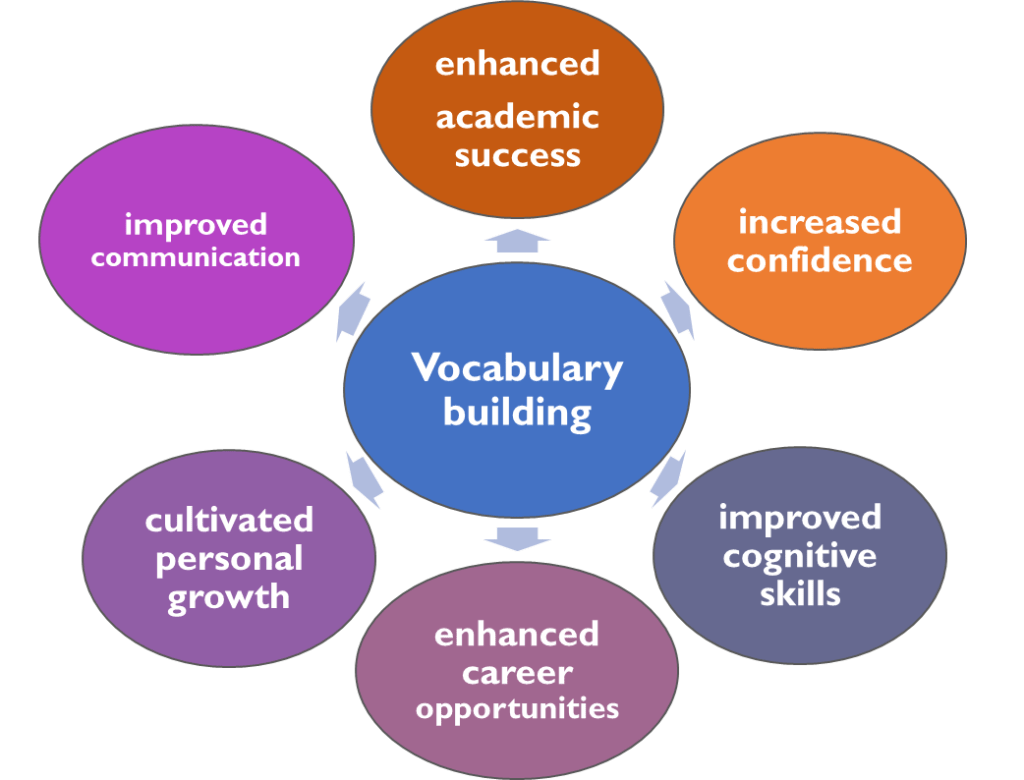
The Oxford Language Report: Why Closing the Word Gap Matters (2018) says vocabulary is a huge predictor of success at school and beyond. Advanced vocabulary helps kids connect thoughts and understand their world, laying the foundation for effective communication.
Adults, too, benefit from a rich vocabulary. Whether it’s writing an email, chatting with friends, or giving a presentation, a varied vocabulary boosts confidence and impresses at dinner parties. There’s something satisfying about finding just the right word!
Having the right words on hand allows you to precisely communicate feelings, describe experiences, and make sure people know you didn’t just have a “nice” day, but a “phenomenal” one. And who doesn’t love that? Vocabulary development links closely with cognitive skills like memory and processing speed, making you not only articulate but also quick-witted—perfect for those moments when you need a snappy comeback.
Building a strong vocabulary also enhances reading comprehension. In his 2019 study, How many words do we read per minute? A review and meta-analysis of reading rate, Marc Brysbaert explains that having a richer vocabulary leads to faster reading and better understanding, which in turn improves daily interactions.
Vocabulary can even change how you experience everyday life. Knowing a word like “serendipity” lets you smile at happy accidents, and understanding “catharsis” helps you explain why a good cry after a sad movie actually feels kind of fantastic.
So, dive into the world of words. Whether you’re a student, a language lover, or just want to sound sharp, expanding your vocabulary is a worthwhile adventure. You might discover a new favourite word—or at least a few that make you smile! My daughter uses “gregarious” whenever she can.
And now, you might wonder, “Okay, it sounds good, but how do I actually do it?” Let me share my experience with you.
My Experience in the Classroom
I’ve seen students on both ends of the vocabulary-learning spectrum. Some give up too quickly, thinking they’ll never master new words, while others lack the right tools and strategies to retain vocabulary. They often give up before even trying, saying things like, “I can’t do that” or “I don’t know how to learn.” Others believe, “I’m too stupid; I can’t learn.” I couldn’t help but wonder how we got here. Why do so many feel this way?
Here’s what I’ve learned: every student can improve their vocabulary. With the right strategies, anyone can go from feeling lost to feeling confident in their ability to use new words. I always tell my students that learning vocabulary doesn’t have to be painful and overwhelming. In fact, it can be fun!
We often think of words as static, but they are alive, shaping our experiences. When students start using words in context—whether in writing, conversation, or real-world applications—they begin to see real progress. The process becomes not only easier but also rewarding. The challenge is to make learning appealing, and once students realise they are doing well, you’ve won the battle. They feel more confident and enjoy learning, wanting more.
Take JJ, for example. He came into class convinced he would never grasp more than a few basic words. His frustration was palpable, and to hide it, he misbehaved. But after trying some creative learning methods—like word associations and fun group games—he started remembering words. One day, he came first in a game of vocabulary dominoes. Seeing the pride in his eyes was priceless. It wasn’t just about winning the game; it was about proving to himself that he could do it.
The Real Struggle: Why learning Vocabulary Can Feel Hard
Feeling Overwhelmed
So, why is learning new words such a struggle? For many learners, vocabulary can feel overwhelming, leading them to give up before even starting. You may feel like there’s just too much to memorise. This feeling of cognitive overload—when your brain is bombarded with too much information at once—can cause learners to shut down. A study by Aslihan Kurt (2020) explains how cognitive overload leads to poor retention, leaving learners feeling discourage and demotivated.

When vocabulary learning is presented without proper context or pacing, it becomes harder for students to absorb, leading to frustration. Picture this: your brain is like a sponge. If you pour too much water on it at once, it becomes saturated and can’t absorb any more. But if you add small amounts steadily, it stays effective. Vocabulary learning works the same way.
What about the Mindset
While cognitive overload could be discouraging, the mindset with which students approach learning can be equally influential.
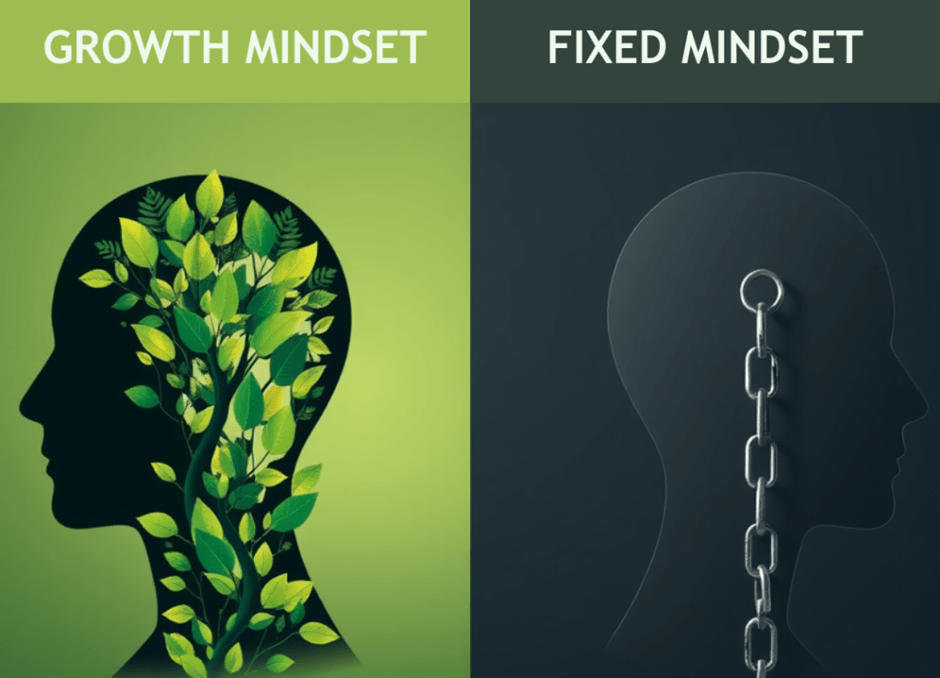
Many people develop what’s known as a fixed mindset, a term coined by psychologist Carol Dweck (2019). In this mindset, people believe that their ability to learn is fixed—either you’re good at it, or you’re not. So, if they struggle with learning a new language for example or building their vocabulary, they might think, “I’m just not good at it.” But here’s the catch: Dweck’s research shows that adopting a growth mindset—the belief that you can improve with effort and the right strategies—can completely change the game.
When you understand that everyone can improve their vocabulary with practice, learning becomes less intimidating and much more achievable, students start to see challenges as opportunities to grow, rather than proof of failure.
The Problem with Rote Memorisation
Another issue we need to highlight is the exclusive use of rote memorisation. You’ve probably been there: sitting with a long list of words, repeating them over and over, hoping they’ll stick.

Let’s be real: memorising word lists can feel about as exciting as watching paint dry. But it doesn’t have to be! Learning new words can become something you actually look forward to—if you do it right. Language learning expert Gianfranco Conti emphasizes that rote memorisation alone won’t get you far.
While useful for quick recall of definitions and spellings, rote memorisation needs context and real-life repetition to truly stick. Conti also warns of cognitive overload from cramming too much information.
Instead of relying solely on repetition, successful vocabulary learning involves using words meaningfully—in conversations, writing, or various scenarios. This approach helps you retain and recall words more effectively, boosting your ability to use them when it counts.
A Structured Approach to Effective Vocabulary Learning
I spent countless hours reading, researching, analysing, and observing, resulting in a learning approach that truly works. It’s simple and effective. Learning vocabulary requires a structured step-by-step method to ensure words are understood, remembered, and used naturally.
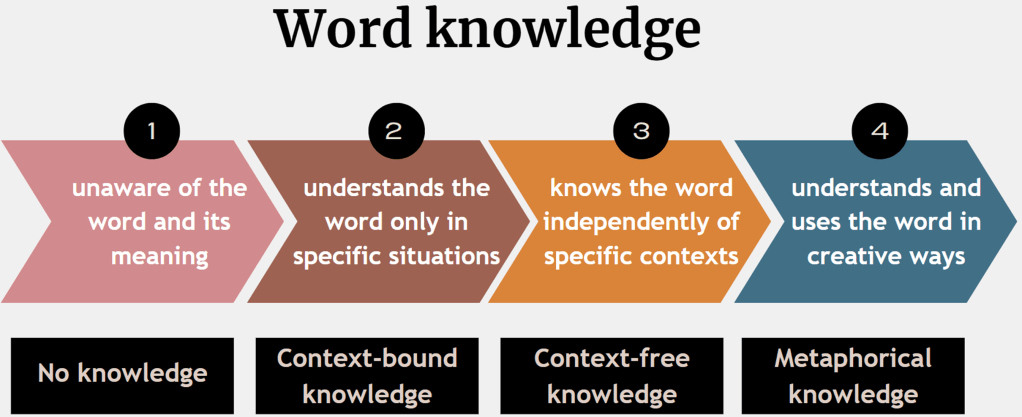
Because we don’t want learning to be boring or daunting, spending 10 minutes per day in engaging activities should be enough to learn about 10 new words per week. In the next part, I will present the small steps to achieve our goal; their benefits and give examples. Remember, an activity a day, no more than 10 minutes.
The small steps

Grouping Words
When learning – or teaching – groups of work, start by grouping them according to something they have in common, being sound, pattern, meaning… this will make memory recall easier. I like to group new words according to their meaning. Below, we will focus on a set of 10 words grouped under “Intellectual Qualities”.

Learning Definitions
Focus on learning the definitions of the words. Semantic precision deepens our understanding and leads to stronger, longer-lasting retention (Schmitt, 2019). Spend just 5 minutes on the definition and try to complete the following crosswords:

Mastering Spelling
Mastering spelling strengthens memory pathways and makes it easier to recognise and retrieve words later on (Bai, 2020). Same group of words, spend 5 more minutes on the definitions and then try to unjumble the letters – if stuck, it’s ok to use a clue like a quick glance at the definitions.

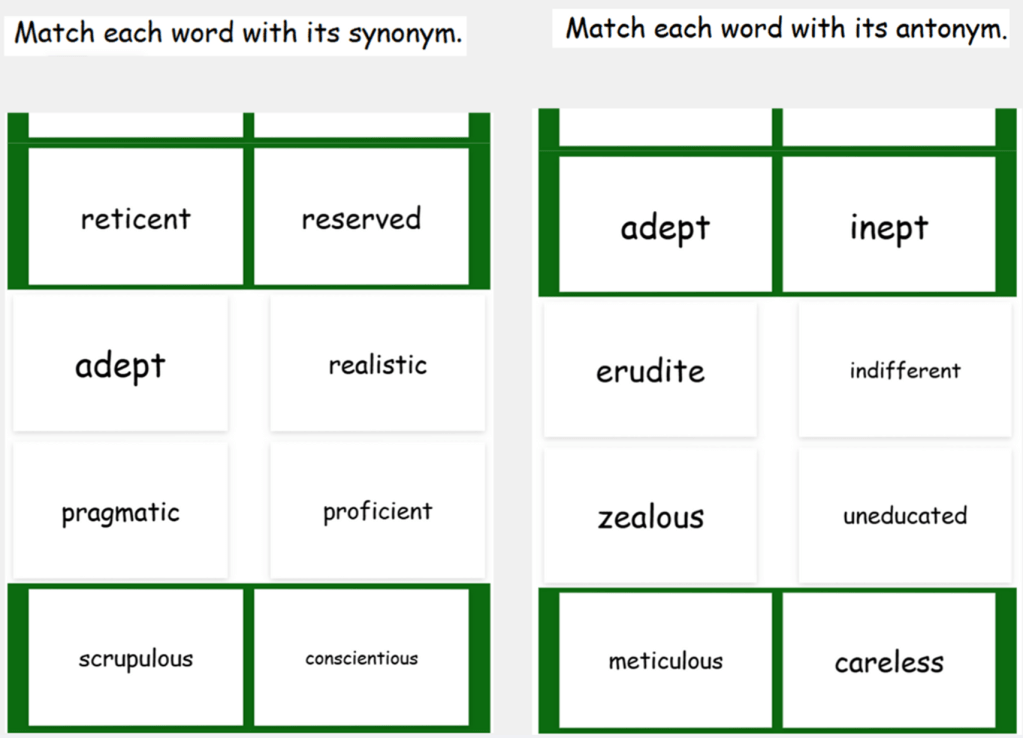
Learning Synonyms and Antonyms
Next, learn synonyms for quicker retrieval of words and meanings. Building these connections creates a web of associated words that helps you find the right one faster (Nation & Webb, 2021). Similarly, learning antonyms deepens these connections, ensuring recall of both similar and contrasting words when needed (Webb et al., 2020). Spend 4-5 minutes on the definitions and try to complete the dominoes game.
Contextual Usage
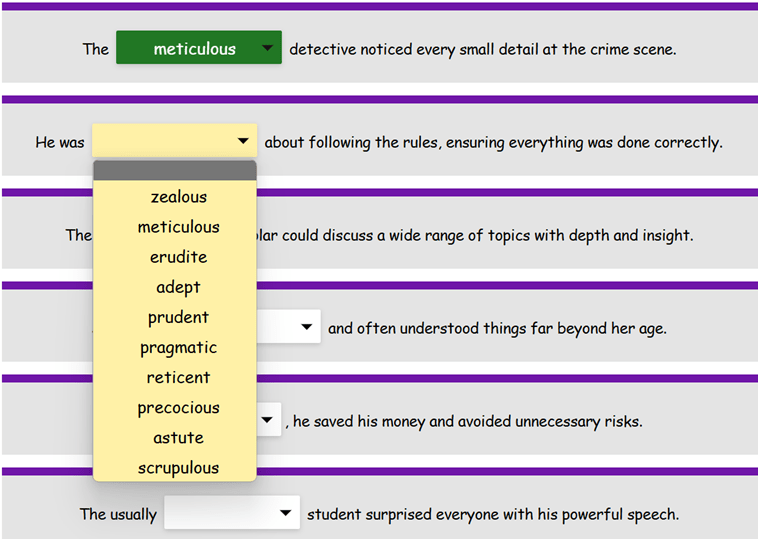
Practise vocabulary in context by filling gaps with the correct word, reinforcing understanding of synonyms, antonyms, and nuanced meanings effectively. Recent studies show that seeing how words fit into real-life sentences enhances our ability to use them correctly and reinforces memory (Ellis, 2020). In this gap-fill task, try to find the right word for each gap. You can add a clue indicating whether you need a word from the set, a synonym or an antonym. If played online, gap-fill can give instant feedback by allowing to select only the correct word.
Creative Writing
With creative writing, we personalise new vocabulary and apply it meaningfully. This step encourages deeper engagement and helps internalise the word’s meaning (Gonzalez et al., 2021). Writing about a subject you enjoy helps your brain retain the new words. Here, I chose the theme ‘travel’. As feedback and reflection help with memory recall, have someone read your text or if you are not comfortable with that, read it again asking yourself if you have used the right words in the right place and how you could improve your writing.

Conversation Practice
Conversation for dynamic practice strengthens retrieval by forcing us to recall and use words spontaneously in speech. This step is critical for solidifying long-term memory and improving fluency (Browne & Culligan, 2022). From now on, we are going to use at least 3 words per day; neighbours, friends, family, colleagues, teachers, acquaintances, loads of opportunities to sound interesting, sharp and feel more confident in our social life.

Retrieval Practice
After taking small steps, we’ll need some retrieval practice. These two words are often heard in the education system. But what is it, and why do we have to use it?
The What. Retrieval practice is an active learning technique where you recall information from memory rather than passively reviewing notes. This method can include self-quizzing, using flashcards, or answering questions without looking at the answers. Actively retrieving information strengthens memory and improves recall ability.
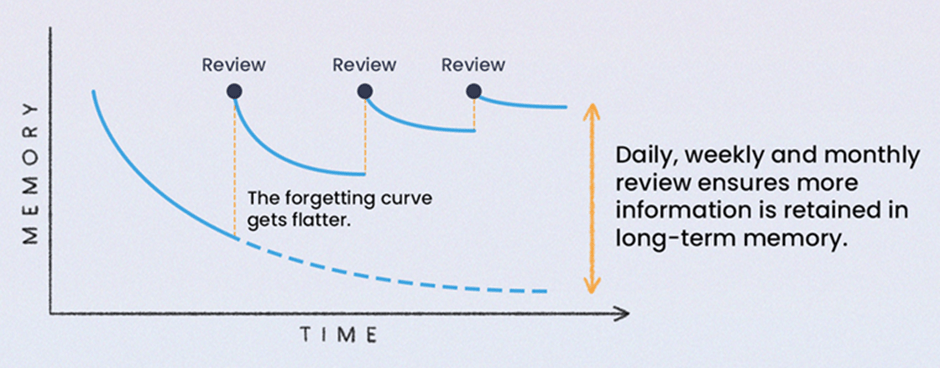
The Why. Retrieval practice works because it helps us retain information for longer. Ebbinghaus’s research shows that we forget quickly without review, but revisiting what we’ve learned strengthens memory over time. In his book How We learn, Carey’s idea builds on this, suggesting that forgetting isn’t a failure—it’s part of the process. Struggling to recall and relearning makes memories stronger. Both agree that retrieval, also called spaced practice, is the key to effective, long-term learning.
Now that we have seen the ‘What’ and the ‘Why’, let’s talk about the ‘How’.
The How. We begin with daily reviews during the first week, where we spend a few minutes, each day looking at our definitions before completing our activities. Gradually, we extend these retrieval sessions to weekly, and then monthly intervals. Our goal is to learn 10 new words per week. Thus, we will review the words learned in Week 1 during Week 2, Week 4, Month 3, and Month 6. Although these intervals are estimates and may not apply universally, this spaced repetition technique maximises memory retention and enhances vocabulary building.
The forgetting curve by Ebbinghaus:
Make it Fun and Engaging
One of the biggest challenges I encounter when teaching vocabulary, is engaging every single student. There are always some students eager to learn, others who want to please the teacher, and those who can’t be bothered. However, in every class, there are always those who seem unattainable. No matter what you do, they show disinterest, often to hide a learning issue they have or think they have.
I know that learning vocabulary is important; it’s a life-changing game. A broad vocabulary will open doors students can’t imagine yet, but simply telling them that isn’t enough to convince them. Take Steve, for example, who would rather be on his phone or playing football than sitting in the classroom.
Believing in Their Ability
To engage Steve, two factors were crucial:
- Believing in Their Ability: They need to know you believe in their capacity to learn and reach their full potential.
- Challenging Them: Especially for boys, setting a timer, organising team games, counting points, and using ICT can provide the necessary stimulation. This approach works, even with the most reluctant students.
Those are the same factors you need to learn vocabulary. First, I believe in you. I do believe that every human being can achieve amazing things. Second, learning has to be enjoyable. My mentor once told me: if your class doesn’t like learning, make it fun. A structured and systematic approach with the right level of challenge will boost your vocabulary and build your confidence. It worked for Steve; it worked for me, and it will work for you.
Using Puzzles and Quizzes
To make vocabulary building enjoyable, I incorporate puzzles and quizzes. Puzzles engage both critical thinking and memory, while quizzes build confidence and keep motivation high with instant feedback. Frequent feedback is crucial, as immediate corrections prevent errors from sticking. Once an error sticks, it takes considerable effort to correct it.
There are numerous online quizzes available to help improve and test your vocabulary. My advice is to learn with friends and, a couple of times a week, play a quiz together and see who will buy the next coffee!
Share Your Experience
What’s the most intriguing new word you’ve discovered recently? Share it in the comments, and let’s have some fun incorporating it into our daily conversations. Together, we can make learning vocabulary a creative and enjoyable journey!
Best, Saloua


 The Vocab Project
Leave a comment